
Segredou, E. (2026). Conflict as the Language of the Unspoken: Mythological couples and clinical readings. Systemic Thinking & Psychotherapy, 29(1), 60–67. https://doi.org/10.82070/syst20262907
Pp 60-67
Abstract
Conflict within the couple often expresses relational meanings, emotions, and needs that have not yet found words. This article approaches mythology as a metaphorical “clinical archive” and explores four mythological narratives—Gilgamesh and Ishtar, Cephalus and Procris, Kali and Shiva, and Eros and Psyche—primarily from a systemic perspective, with psychodynamic concepts serving as complementary bridges to understanding. The narratives illustrate different trajectories of relational conflict: symmetrical escalation, circular causality, de-escalation, and second-order change. At the same time, concepts such as narcissistic injury, projective processes, containment, and recognition of the Other illuminate the emotional processes organized within these relational patterns. It is proposed that the therapeutic task is not to eliminate difference, but to enable the unspoken to be recognized and named, so that the relationship itself can be transformed.
Keywords: couple therapy, systemic psychotherapy, conflict, mythology, relational patterns, the unspoken, transformation
Introduction
When a couple comes to therapy in a state of war, what they are fighting about often extends beyond what they appear to be fighting about. They may seem to disagree over money, children, sex, their families of origin, or even a word spoken in the past; yet beneath the content of the conflict, a deeper relational meaning is often at stake. It is as though they were asking their partner: “Do I matter to you?” “Do you desire me?” “Can I rely on you?” “Will you be there when I need you?”
Within the framework of Emotion-Focused Couple Therapy, Greenberg and Goldman suggest that overt couple conflict is often organized around secondary emotions—anger, attack, blame, withdrawal—while beneath them lie more vulnerable primary emotions and needs: fear of abandonment, shame, feelings of inadequacy, and the need for closeness and security.
Gottman argues that approximately 69% of couple conflicts involve “perpetual problems”—recurring differences associated with relatively stable personality characteristics or with differing needs and ways of life. When these differences become gridlocked, the partners’ entrenched positions often conceal deeper personal meanings, values, needs, and unacknowledged “dreams”.
In other words, the subject of a disagreement may be specific, but the meaning it acquires within the relationship is relational. Thus, behind “you never help me” may lie “I don’t feel that I matter to you”. Behind anger, there may be fear. Behind attack, shame. Behind immobility, panic. And behind silence, at times, a cry that has not yet found words.
It may be useful to approach mythology metaphorically as a kind of ancient “clinical archive”. Myths show us people who love, become jealous, reject, take revenge, fear, merge with one another, are abandoned, and sometimes undergo transformation.
Through this lens, four mythological narratives will be explored: two in which crisis leads to escalation and destruction, and two in which the possibility of transformation emerges from within the crisis itself. These narratives will be approached primarily from a systemic perspective, with an emphasis on relational patterns, circularity, and processes of escalation and transformation. At the same time, psychodynamic and object relations concepts will be used as a complementary lens through which to understand the emotional processes organized within these relational patterns.
Mythological Pathways
1. Gilgamesh and Ishtar: When injury turns into revenge
Our first pathway leads to the Babylonian Epic of Gilgamesh, one of the earliest surviving extended literary works, with a tradition spanning approximately four millennia. At its center are the heroic exploits of Gilgamesh, king of Uruk, as well as his confrontation with mortality and his quest for immortality (George, 2003). Gilgamesh and Ishtar are not a couple in the conventional sense. Yet their brief encounter encapsulates an entire relational sequence of escalating dynamics: desire, a proposal of marriage, rejection, humiliation, rage, revenge, and retaliation.
In Tablet VI of the Standard Babylonian version of the Epic of Gilgamesh, Ishtar, captivated by Gilgamesh’s beauty and valor, proposes that he become her husband, promising him wealth, power, and glory. His refusal, however, goes beyond rejecting her proposal; it becomes an extended and insulting catalogue of her former mortal and divine lovers[1] and the disastrous fate that, according to his account, befell each of them (Abusch, 1986). Rejection thus turns into humiliation, and Ishtar becomes enraged. She asks her father, Anu, to unleash the Bull of Heaven against Gilgamesh. Gilgamesh and Enkidu kill the Bull, and Ishtar is subjected to further public humiliation.
From a systemic perspective, the sequence desire → rejection → humiliation/shame → rage → revenge → retaliation → renewed humiliation can be understood as a form of symmetrical escalation (Watzlawick et al., 1967). Each response, rather than bringing the preceding move to a close, intensifies it and elicits an even stronger counter-response. The conflict gradually becomes a struggle for dominance, in which the original emotional experience is lost behind the mutual escalation.
From a psychodynamic perspective, the rejection and, above all, the humiliation can be understood through the concept of narcissistic injury. Kohut links narcissistic rage to the experience of such an injury and to the need for retaliation or revenge that may follow it (Kohut, 1972). Contemporary empirical findings also support an association between narcissistic vulnerability and shame, on the one hand, and rage and aggression, on the other (Théberge & Gamache, 2023).
The two perspectives—systemic and psychodynamic—can operate complementarily here: the internal experience of injury is expressed within the relationship and, through the other’s response, becomes embedded in a self-reinforcing cycle of escalation.
In such a clinical reading, vulnerable affect recedes, and defense takes its place. Hurt becomes anger. Fear becomes control. Shame becomes attack. Rejection becomes revenge. Ishtar does not say, “You rejected and humiliated me. I am hurt;” she responds by sending the Bull. The Bull of Heaven might therefore be seen as a symbolic embodiment of unspoken affect: what cannot be expressed as “You hurt me” returns as “I will destroy you”.
Yet something analogous can also be seen on Gilgamesh’s side. He does not speak about his own experience in response to Ishtar’s proposal; instead, he speaks about who he believes she is. In effect, he tells her: “I know what you are. You destroy everyone you love”. Here, an important therapeutic shift comes into view: from “you are” to “I feel”. The former defines and accuses the Other; the latter reveals something of one’s own subjective experience. And very often, this is precisely where couple therapy begins.
2. Cephalus and Procris: When fear creates what it fears
Cephalus and Procris love one another. They do not begin as enemies. Eos, however, falls in love with Cephalus and plants in him doubts about Procris’s fidelity. From that moment, the destruction begins. Cephalus disguises himself and decides to test Procris’s faithfulness. He approaches her in the guise of another man, offers her gifts, and persists until she begins to waver. He then reveals his identity. By then, trust has already been damaged. They later reconcile.
But now suspicion has shifted sides. It is Procris who begins to suspect that Cephalus is being unfaithful to her. She hears that, while hunting, he calls out to someone named “Aura”. She assumes that Aura is a woman. She secretly follows him and hides in the bushes to watch him. Cephalus hears a noise, assumes it is an animal, and hurls his unerring spear. He kills Procris (Ovid, Metamorphoses, VII.690–865).
The relationship is destroyed by the very means they use to protect it: control. From a systemic perspective, what we see here is not a linear relationship of cause and effect, but a process of circular causality, a feedback loop (Watzlawick et al., 1967; Curtis, 2024): “I don’t trust you, so I monitor you”. “You monitor me, so I cannot feel safe with you”. “Your distance confirms that you are hiding something. So I need to monitor you even more closely”. The attempted solution thus becomes part of the problem itself, and the cycle becomes self-reinforcing.
From a psychodynamic perspective, the story can also be read through the lens of projection and projective processes (Abrams, 2009). The fear of betrayal does not remain solely an internal experience; it is attributed to the Other and shapes the way the Other’s behavior is interpreted. What is ambiguous—as is strikingly illustrated by aura (“breeze”)—is interpreted through the lens of an already existing fear, while suspicion directs attention toward those elements that seem to confirm it.
Thus, fear is not simply a reaction to an already existing reality. It participates in shaping the relational reality itself, which is subsequently experienced as evidence confirming that fear. The sequence can be represented schematically as follows: fear → interpretation of ambiguity as threat → control/monitoring → alteration of the relational situation → further “confirmation” of the initial fear.
3. Kali and Shiva: When one does not join the same dance
In one of the well-known Indian traditions concerning Kali, the goddess, having destroyed the demonic forces, remains consumed by her battle frenzy. After slaughtering her adversaries, intoxicated by blood, she continues her destructive rampage. Her frenzied dance now threatens not only her enemies but the very world she had been called upon to protect. Shiva intervenes by placing himself motionless in her path, among the dead. Kali steps on him and, when she realizes that it is Shiva beneath her foot, she stops (Kinsley, 1986; Menon & Shweder, 1994, pp. 246–247).
From a systemic perspective, Shiva does something paradoxical: he does not fight her, does not attempt to prove himself stronger, and does not respond to violence with greater violence. He introduces a different response into the interaction, interrupting the destructive pattern and opening up the possibility of de-escalation (Carr, 2025).
From a psychodynamic perspective, Shiva’s stance can be understood through the Bionian concept of containment: he receives the intensity without responding to it in the same form and, through his presence, contributes to its transformation into something more tolerable and capable of being processed (Zachrisson & Wong, 2023). His stillness is not passivity; it constitutes an active form of containment, in which the intensity is tolerated without being immediately returned to the Other.
The way out of the cycle does not emerge when someone wins. It emerges when something previously absent is introduced into the relationship: a pause, a different response, the capacity to tolerate the intensity without immediately returning it in the same form.
4. Eros and Psyche: The crisis that transforms
With Eros and Psyche, we take a further step. At the beginning of the story, Eros enters into an intimate relationship with Psyche under a paradoxical condition: she must not see him. He visits her only at night, and their relationship can exist only as long as his identity remains unseen. Psyche, however, eventually violates the prohibition: she lights the lamp and looks at him. Rupture and separation follow, and Psyche undergoes a series of trials that lead her even to the Underworld. Yet the story does not end there. Psyche returns, attains immortality, and her union with Eros is ultimately restored in a new form (Apuleius, Metamorphoses, V.21–VI.24).
Psyche is transformed not because she is protected from the crisis, but by passing through it. From this perspective, the myth offers a particularly fruitful metaphor for couple therapy. The aim is not always to restore the relationship to what it was before the rupture. From a systemic perspective, this transition can be understood through the concept of second-order change, which refers not simply to changes within an already existing system, but to a qualitative change from which something new can emerge within the relational system itself (Davey et al., 2012). The therapeutic task, therefore, may be to enable a different form of relationship to emerge after the crisis—one that does not reproduce the same conditions and relational patterns that contributed to the crisis in the first place.
From a psychodynamic and intersubjective perspective, the initial relationship between Eros and Psyche can be understood through the concept of recognition. For Benjamin (1995), loving or desiring the other as an object is not necessarily the same as recognizing the other as a distinct subject, with a center of existence of their own. Viewed in this light, the transition depicted in the myth can be understood as a movement from desire for the Other toward recognition of the Other’s otherness. Perhaps this transition can be distilled into a single phrase: “It is not enough to love you. I must also be able to see you”.
The role of the therapist
What, then, of the therapist faced with a couple at war? When two people sit before us and fight, it is very easy to be drawn into the content of the conflict. Who started it? Who betrayed whom? Who is more aggressive? Who is more in the right?
But perhaps the therapeutic question needs to be different. What is trying to be said here but has not yet found words? What lies beneath the attack, behind the silence, behind the control? What is the person who withdraws trying to protect? What transgenerational story is being played out again before us as though it were new? And, above all, how can we help the couple stop experiencing their partner as an enemy and begin to see them once again as an Other?
The therapist is not called upon to win the war on behalf of either partner. Nor is the therapist called upon to eliminate aggression. Aggression is part of relationships, part of human life, and often part of the very desire for contact. The therapist’s task, however, is to help what is being discharged become something that can be recognized and named.
Myths do not tell us that conflict can disappear. They tell us something perhaps more useful: that conflict can take many forms—it can become revenge, repetition, destruction. But sometimes it can also become a path toward something new.
Napier reminds us that within the couple relationship, earlier relational experiences, fears, and traumas are often reenacted with new protagonists, and that both partners unknowingly participate in the co-construction of this recurring drama. Yet the partner is not only the person with whom we reenact an old relational script. Precisely because the partner is an Other, coming from a different relational world, they may also become the person with whom we can differentiate ourselves from that old script—so that the couple no longer needs to repeat it, but can instead write a new one.
Epilogue
A central therapeutic challenge in couple therapy, then, is not to eliminate difference, nor to return the couple to an idealized previous state, but to enable two different people to remain in relationship without having to fight in order to be heard.
For what remains unspoken struggles. But when it can be spoken, it no longer needs to fight.
[1] such as Dumuzi—known in Akkadian as Tammuz—and the gardener Ishullanu
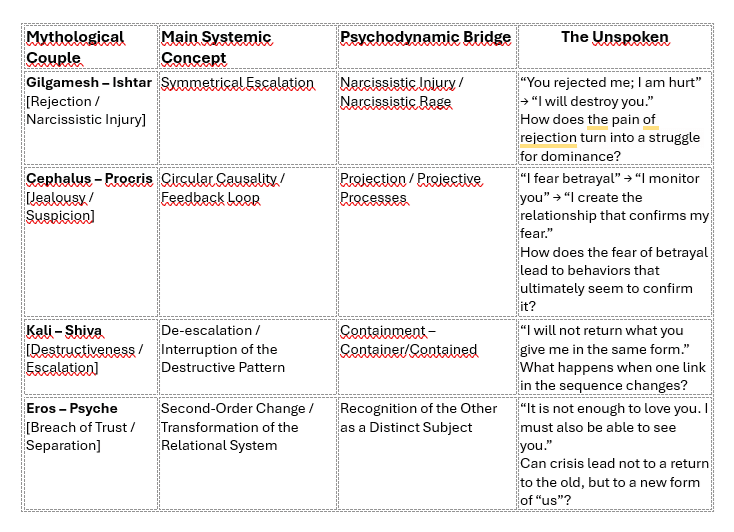
Table 1. Mythological Couples: Systemic Concepts, Psychodynamic Bridges, and the Unspoken
[1] such as Dumuzi—known in Akkadian as Tammuz—and the gardener Ishullanu
REFERENCES
Abrams, J., What’s reality got to do with it?: Projective processes in adult intimate relationships, Psychoanalytic Social Work, 16(2), 126–138, 2009. https://doi.org/10.1080/15228870903200319
Abusch, T., Ishtar’s proposal and Gilgamesh’s refusal: An interpretation of The Gilgamesh Epic, Tablet 6, lines 1–79, History of Religions, 26(2), 143–187, 1986. https://doi.org/10.1086/463073
Apuleius. (1990) Cupid and Psyche. E. J. Kenney (Ed.). Cambridge: Cambridge University Press.
Benjamin, J. (1995) Like subjects, love objects: Essays on recognition and sexual difference. New Haven, CT: Yale University Press.
Carr, A., Couple therapy and systemic interventions for adult-focused problems: The evidence base, Journal of Family Therapy, 47, e12481, 2025. https://doi.org/10.1111/1467-6427.12481
Curtis, M. G., Dynamic narrative therapy: A metamodern integration of narrative, and strategic family therapy, Contemporary Family Therapy, 46(4), 471–485, 2024. https://doi.org/10.1007/s10591-024-09694-z
Davey, M. P., Davey, A., Tubbs, C., Savla, J. and Anderson, S., Second order change and evidence-based practice, Journal of Family Therapy, 34(1), 72–90, 2012. https://doi.org/10.1111/j.1467-6427.2010.00499.x
George, A. R. (2003) The Babylonian Gilgamesh epic: Introduction, critical edition and cuneiform texts (Vols. 1–2). Oxford: Oxford University Press.
Gottman, J. M. (1999) The marriage clinic: A scientifically based marital therapy. New York: W. W. Norton & Company.
Greenberg, L. S. and Goldman, R. N. (2008) Emotion-focused couples therapy: The dynamics of emotion, love, and power. Washington, DC: American Psychological Association. https://doi.org/10.1037/11750-000
Kenney, E. J. (1990) Psyche and her mysterious husband. In D. A. Russell (Ed.) Antonine literature. Oxford: Oxford University Press. Pp. 175–198. https://doi.org/10.1093/oso/9780198140573.003.0007
Kinsley, D. R. (1986) Hindu goddesses: Visions of the divine feminine in the Hindu religious tradition. Berkeley, CA: University of California Press.
Kohut, H., Thoughts on narcissism and narcissistic rage, The Psychoanalytic Study of the Child, 27(1), 360–400, 1972. https://doi.org/10.1080/00797308.1972.11822721
Menon, U. and Shweder, R. A. (1994) Kali’s tongue: Cultural psychology and the power of shame in Orissa, India. In S. Kitayama and H. R. Markus (Eds) Emotion and culture: Empirical studies of mutual influence. Washington, DC: American Psychological Association. Pp. 241–282.
Napier, A. Y. (1988) The fragile bond: In search of an equal, intimate, and enduring marriage. New York: Harper & Row.
Ovid. (1916) Metamorphoses (F. J. Miller, Trans.; Vol. 1, Books I–VIII). Cambridge, MA: Harvard University Press; London: William Heinemann.
Théberge, D. and Gamache, D., An appraisal of narcissistic rage through path modeling, Journal of Interpersonal Violence, 38(1–2), NP796–NP818, 2023. https://doi.org/10.1177/08862605221084746
Watzlawick, P., Beavin, J. H. and Jackson, D. D. (1967) Pragmatics of human communication: A study of interactional patterns, pathologies, and paradoxes. New York: W. W. Norton.
Zachrisson, A. and Wong, M., Containment, affirmation and structural deficiency – revisiting an issue in psychoanalytic method, The Scandinavian Psychoanalytic Review, 46(1–2), 49–56, 2023. https://doi.org/10.1080/01062301.2023.2296689