

_ This article is a translation of the original article, which was published in the journal Quaderni SIRTS, DOI:10.48299/QS6-2025-003-047_ ISSN: 2705 – 0300, Issue 6, Year 2025 ABSTRACT
It often happens that you find yourself in a deadlock during therapy and realize that you are unable to "go beyond", to break the patterns of the session that seem to repeat themselves identically over time or to realize that you are unable to address certain issues. The therapist is called upon to try to make a cognitive leap to try to understand what is happening to him, to the patient, to their relationship, to what they are co-generating in that moment. It is precisely from a moment of deadlock in a therapy in which the authors had to appeal to their curiosity and self-reflexivity: they were unable to feel and address the topic of emotions with a couple. Thus was born the FA.G.E. tool, invented by them, used and taught for several years, as a method for working on emotions in therapy. This contribution shows how it was thought and conceived, which theoretical, epistemological assumptions and clinical maps guided the authors in its definition, and how it was then implemented in practice based on the different clinical cases. The reader of this article will be able to follow step by step the dialogue between the two therapists that triggered the reflection between them and how they finally came to invent this tool; he will be guided in discovering how the administration actually happens, in which types of settings it can be applied, and what feedback it has generated in the patients who have used it.
KEYWORDS: Systemic Therapy - Emotions - Curiosity - Relationships - Connections - Othervision - Impasse
“From time to time it happens that one forgets a particular word for quite a long period of time—perhaps several weeks—and cannot retrieve it when needed. In such cases one experiences a particular kind of frustration that resembles no other, and begins searching for a synonym that inevitably proves unsatisfactory. Recently, for me, the word was demotivated. I simply could not recall it. I replaced it with discouraged or disinterested, but it was not the same thing. I wanted demotivated, yet it was not there. Then one day, suddenly, that word returns: at last you remember it, and you become convinced that from that moment on you will never forget it again”. (Da Silva, 2011)
INTRODUCTION
The couple arrives punctually for the session, as always. They greet politely and move confidently within the therapeutic setting, now familiar after several sessions already conducted, and they leave us our “usual seats”.
This is the initial feeling of the therapists, a feeling that has been repeating itself for several sessions—our usual seats. The therapists now clearly know the pattern that will occur during the session: after the greetings, a brief account of how the couple has spent the time between one session and the next, followed by a discussion of the tasks assigned at the end of the previous meeting. The therapists once defined them as an “obedient couple”. They have never failed to complete an assigned task, always adding their own creativity and innovation. They are a couple who work a great deal between sessions, a couple who should make the therapists feel satisfied and gratified by the work they are doing with them. Yet whenever the focus shifts to investigating emotions—to speaking about emotions—the couple freezes and silence always descends. For several sessions the therapists have perceived this sense of the couple “being comfortable sitting in their chairs”. Certainly, it is a couple that is present, active, thinking, reasoning, acting—but feeling? And how can one feel if one does not feel emotions? Today, however, the therapists are determined. They want to discover what pattern between the two members of the couple—and between the couple and the therapists themselves—generates this blockage, where everything works, everything is understood, everything evolves, but nothing, it seems, can actually be felt. From this opening situation a discussion begins behind the mirror between the therapists. This discussion will lead them along new paths, using as maps and compasses both their previous knowledge and their professional styles, until they eventually invent the F.A.G.E., readapting the idea of the family genogram (Humphrey) into the idea of constructing a family genogram of emotions. In this contribution we will present, through the use of clinical maps, the theoretical and epistemological assumptions underlying the construction of the F.A.G.E. This will be followed by a description of the instrument, its structure, how it works, how it is administered, and how it is concretely applied. Finally, the contexts in which it can be used will be presented, along with some feedback from patients to whom it has been administered. For the sake of greater simplicity and explanatory clarity, the original case (cited in the opening) of couple therapy will not be used; instead, everything will be illustrated through an individual therapy case.
DIALOGUE IN A MOMENT OF THERAPEUTIC IMPASSE
Adelaide comes to therapy because she states that she lives a monotonous life: nothing goes particularly well and nothing goes particularly badly. She says she has nothing to complain about, yet she feels dissatisfied and does not really know why or about what. We have now reached the fourth session and the script seems to repeat itself exactly as before.
T: “Good morning”.
A: “Good morning, doctor”.
T: “How are you? How are you today?”
A: “Well, you see, it’s always the same thing… I don’t understand… I can’t give myself an answer. I’m always down, always a bit discouraged. I don’t feel like doing anything, I don’t know… I thought about everything we said, I tried to listen to myself a bit, to feel something… but I didn’t understand much. I can’t feel, I can’t understand what is happening inside me… I don’t know, doctor. Nothing is really wrong, everything is fine… but… I don’t know”.
Only a few moments have passed since the beginning of the session and here it is again, right in front of me: the recurring pattern.
The time to sit down, exchange a few sentences, and the room—she, I, and this space—has regenerated the usual pattern. We are back to the usual. I feel powerless with this patient. I feel trapped. I have tried everything: even changing chairs, asking her to change seats, re-signifying experiences, narrating new stories, moving back and forth between past and future and return. Nothing. The recurring pattern is always here between us. There must certainly be something that I cannot see, something that I cannot grasp. I decide to interrupt the session and go behind the mirror to talk and ask for help from my co-therapist. Perhaps from that position she may have grasped something that is escaping me.
Citterio:
“What do you feel? How was the session with her?”
Iori:
“Her constant ‘I don’t know’ and the inability to name what she feels or experiences are generating in me feelings of boredom, anger, frustration, and powerlessness. And I ask myself: how can I generate change and help her? How can I turn on her emotions and access them? How can I open other paths? What tools can I use to get out of this impasse, both hers and mine, activating my curiosity? I feel that with words alone I cannot manage it. I cannot break the usual pattern that traps us”.
Citterio:
“We should consider developing a tool that could help make the patient’s emotions more visible and accessible, something that could encourage her to reflect on her emotional world and to see the connections among her emotions. Such a tool might also stimulate your curiosity and help you move beyond the sense of blockage you are experiencing at the moment.
For example, we might imagine something that has the structure of a family genogram: it would allow us to work on the connections, bonds, and relationships among emotions. An emotion does not arise out of nothing, and through the graphic form of a genogram it might become possible to see where it originates, what relationships it has, and what it can generate.
Through questions, we could then allow the patient’s emotional system to emerge, discovering prejudices and stereotypes that may be present”.
Iori:
“I like this idea; it seems to make a great deal of sense. In that case, we could begin with the emotion that the patient repeatedly brings to therapy, or with one that is particularly significant for her at this moment, and from there develop at least three generations. She could then give the emotion a name, perhaps also assign it a gender, and identify the relationships it has with the other emotions. Once the construction is completed, how should we proceed? How can we generate questions that create connections, give meaning and value to each emotion that has been written, and help us construct a new story together with the patient?”
WHO CAN WE ASK FOR HELP?
Thus we began searching within our own internal voices to determine whether our idea could have not only a practical meaning but also a logical one and whether it could be supported by theoretical and epistemological foundations. First step: change channel. We move from purely verbal discourse to asking the patient to do something during the session in order to short-circuit the pattern that the therapist and the patient trigger from the very first moments of the session.
The aim is to experiment with other ways of conducting the session in order to generate a new thinking mind. Bateson reminds us that we are a unified whole: “The individual mind is immanent, but it is not immanent only in the body; it is also immanent in channels and messages outside the body. There is a larger Mind of which the individual mind is a subsystem”. The attempt to separate the intellect from emotion is monstrous, and in my opinion it is equally monstrous and dangerous to attempt to separate the external mind from the internal one, or the mind from the body”. And again: “It can be said that the mind is immanent in those cerebral circuits that are entirely contained within the brain; or that the mind is immanent in the circuits contained within the system composed of brain and body; or, finally, that the mind is immanent in the larger system: the human being together with the environment”. (G. Bateson, 1972)
Within our way of understanding clinical practice, therapy is therefore not only language and dialogue, but also body, actions, and emotions.
Second step: propose something that may appear absurd, namely asking a person to work on an emotion by writing it on a sheet of paper—especially an emotion that the person does not handle easily. Why this apparent absurdity? As demonstrated by neuroscience: “Neither animals nor human beings are born with an innate, preinstalled fear of bears. When we are born, we are predisposed to respond emotionally, in a preorganized way, when certain characteristics of stimuli are perceived in the external world or within our own body. Individually or in combination, these characteristics are processed and trigger the establishment of a bodily state typical of an emotion. This, in turn, modifies cognitive processing so that it becomes adapted to the emotional state we are experiencing”. (A. R. Damasio, 1995) Thus we are all organized with emotions inside us that originate from the body, from the non-verbal, and only afterward become associated with and elaborated cognitively. First we act them, as our patient does: she feels things but does not know how to name them, she does not know whether the name is the correct one, she does not know where they come from—but they are there. Therefore we begin precisely with that emotion—the most difficult one for the person, the one that still has no words—and we ask the patient to transform it into a “concrete object outside herself” by writing it at the center of a sheet of paper.
We place it there with the name that the person gives it at that moment. Indeed, we therapists speak about emotions, but patients are not experts in psychology textbooks. For them, almost anything can be called an emotion. We have encountered F.A.G.E. maps that begin with emotions such as “back pain,” “eroticism,” “future,” “stomach ache”.
We accept everything, drawing on what neuroscience teaches us: the step following emotional reaction would be to perceive the emotion in connection with what triggered it. At the same time, emotional reactions depend on people’s history and experiences: “If emotions arise from representations acquired through experience rather than from an innate package, they are therefore unique. They may be more or less different from those of others, but they belong to the subject”. (A. R. Damasio, 1995) For this reason we accept even those emotions that are not properly defined in psychology textbooks as emotions. This only stimulates our curiosity during the interview phase, when we ask the person about each single emotion written on the paper, inviting them to explain it and attempting together with them to understand the connections through which their experience became linked to that feeling, which later received the name of the emotion we are discussing. Neuroscience goes even further, stating that: “The neural basis of the self lies in the continuous reactivation of at least two sets of representations. The first concerns representations of key elements of an individual’s autobiography, on the basis of which a notion of identity can be repeatedly reconstructed through partial activation in topographically organized sensory maps”.
The set of dispositional representations that describe any of our autobiographies concerns a large number of categorized facts that define our person: what we do, who we are and what we like, what kinds of objects we use, which places we frequent, and which actions we perform most often. In addition to these categorizations, there are also unique events from our past that are constantly activated as representations projected onto maps: where we live and work, what job we do, what our name is and the names of our closest friends and relatives, our city, our country.
Finally, within recent dispositional memory there is a collection of events close in time together with their approximate temporal projection, as well as a collection of projects and a number of imagined events that we intend to bring about or expect to happen. The incessant reactivation of updated images concerning our identity—a combination of memories of the past and of projected futures—constitutes a considerable part of the state of the self. The second set of representations consists of primitive representations of an individual’s body: not only how the body has been in general, but also how it has been most recently, just before the process that led to the perception of object X. This necessarily includes background states of the body as well as emotional states”.
(A. R. Damasio, 1995) Van der Kolk, finally, may help explain the patient’s persistent “I don’t know,” which often leaves the therapist feeling powerless and without resources. From emotions emerge background feelings that are neither overly positive nor overly negative, although they may be perceived as extremely pleasant or unpleasant and may correspond to the feelings we experience in everyday life: “Of a background feeling we have only a subtle awareness; it corresponds to the bodily state that prevails between one emotion and another. It is our image of the landscape of the body when it is not agitated by emotions. When background feelings remain of the same type for hours or days and do not change with the ebb and flow of the contents of thought, they contribute to the formation of a mood: good, bad, or indifferent. Without background feelings, the very core of the representation of the self would be shattered”.
(B. Van der Kolk, 2015). Third step**:** to construct a family genogram of that emotion, asking the person to relate it to other emotions, thereby creating an emotional system. Bertrando teaches us that: “Even in systemic clinical practice, in recent years people have begun to speak of emotions as an emotional system: every moment in which I am together with (at least) another person, a system of relationships is created, and this system also has emotional characteristics. Moreover, even when I am alone with myself, I still live in relation with thoughts, fantasies, and expectations that connect me to other people and that have emotional connotations. Therefore, we can say that every human system is also an emotional system,” (Bertrando, 2014) However, we cannot take for granted the connection between the emotional system and verbal and non-verbal communication, since showing emotions is not the same as feeling them: “In general, I live within a flow of events; I am immersed in what I do and I do not always pay attention to what I feel,” and again, “emotions are ways of coordinating with others, automatic and unconscious. If I become aware of them and possibly understand them, I will not, as Aristotle might have said, be possessed by the passions” (P. Bertrando, 2014). How these emotions will connect with one another in the F.A.G.E**.**, what links, relationships, and connections they will create, cannot be known in advance by us and very often not even by the patient, who gradually discovers—while writing them down—how emotions are connected within her. Tomkins, in this regard, states that:
“Emotions always combine with one another: there is no necessary bond between one emotion and another. Any emotion can evoke any other according to the personality of the actors, their history, the way in which each emotion is dominant or silent for each individual, and also according to the dominant or silent emotions that emerge in interaction” (S. Tomkins, 1984).
At this point, the moment of impasse is overcome because our curiosity is activated: we want to discover and investigate every word that will be written, what specific meaning it has for the person, what story it contains, what connections it carries, and why precisely those links and those connections exist between those emotions. The therapist’s mind begins to fill with countless questions; it is reactivated, moving beyond the impasse created by the redundant pattern. As Gianfranco Cecchin said: “Curiosity helps us continue searching for different descriptions and explanations even when we are unable to imagine others” (Cecchin, 1987).
Fourth step: we have already experienced the power of this tool for us as therapists, in its ability to reactivate our curiosity and place us in a new position. But what about the patient? Will it be useful for her? As therapists, we are called to adopt a position that facilitates the creation of practices that help both therapists and patients experience novelty, both in terms of new ideas and new behaviors. The aim of the therapeutic encounter is not to change the person or their behavior, but rather to build together concrete possibilities for introducing novelty alongside what is already known, allowing them to communicate with each other and gradually transform. “Like curiosity, other-vision helps us search for different explanations and descriptions when they do not seem possible. With other-vision, actions are created that offer the therapist and the patient the possibility of positioning themselves differently with respect to time, roles, culture, beliefs, emotions, and symptoms. Like curiosity, other-vision helps us search for different explanations and descriptions when they do not seem possible. Therefore, as professionals working within relational contexts, we are called to assume a position that facilitates the discrimination, promotion, and creation of practices that help both ourselves and our clients experience ‘novelty,’ both as a semantic position (new ideas) and as an organizational position (new behaviors)” (A. Caruso, 2015).
COULD THIS BE THE RIGHT TOOL?
We decide to use the tool during the session. But how should we introduce it to the patient? How should it be explained, and what instructions should be given?
T: “Today we thought of working with a new tool. To begin, I would like to ask you about the mood you often describe during the sessions, the one you also brought here today in the first moments of our meeting… when you talk about it to yourself or describe it to other people, what do you call it?”
A: “Apathy”.
T: “I would now suggest that we try to construct a genogram—a family tree—of Apathy. We will use the board. Would you like to write?”
A: “Yes, I’ll do it”.
T: “Okay, you’ll find some markers there. Choose the color you prefer and write in the center of the page: Apathy”.
T: “I know this question may seem a little strange: do you feel this emotion as male or female?”
A: “In what sense? Do I have to give it a gender?”
T: “Try to think about the emotion when you feel it and listen instinctively to whether it feels male or female. Do I feel this emotion as male or female?”
A: “Female… female… It’s me.”
T: “Apathy is born from two parents. Our genogram can include any type of family: two parents of the same sex, a single parent, more than two parents… feel free to write all the emotions you perceive as parents generating Apathy. From which emotions do you feel Apathy is generated?”
A: “Can I also use terms that are not strictly emotions?”
T: “Of course”.
A: “Well… certainly… Fear”.
T: “I will ask you again whether you perceive Fear as male or female”.
A: “Female. Then… the other parent… I don’t know how to define it… it’s a bit like a sense of emptiness. I’ll write Emptiness… and that one is male”.
T: “So Fear and Emptiness generate only Apathy? Does Apathy have brothers or sisters?”
A: “No, no”.
T: “Is Apathy married to someone?”
A: “Yes, but I don’t know what to write; I’m not really sure what it is”.
T: “If you wish, you may write a question mark. Does Apathy, married to the question mark, generate something? Do they have children? And perhaps you could also assign dates of birth?”
A: “Well, I don’t know… I know that Apathy generates Anxiety, which is female, with a question mark in 2021. Then by itself it generates Sadness, which is female. Disappointment is male and Loneliness is also male. Anxiety alone then generates Fear, male, and Fear alone generates Block, which is female. I think that’s all”.
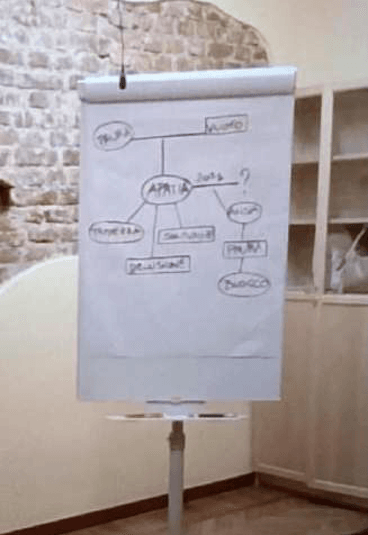
Figure 1: First F.A.G.E.
Once the patient has graphically completed her F.A.G.E., the therapist—who until that moment has taken on the role of facilitator of the instrument, never intervening in the construction, without suggesting emotions, without asking questions about what is being produced, but simply facilitating the patient in the construction when necessary or silently waiting for the autonomous development of the F.A.G.E.—resumes a more active role and moves to the interview phase. Here the therapist draws upon all their curiosity in order to generate alternative vision in both themselves and the patient.
T: “Do you feel it is fine like this? Is it complete?”
A: “Yes, this is what I usually feel. Perhaps it comes to mind because it is recent… maybe because the question mark was born in 2023”.
T: “If you would like to sit down, facing the board, I would ask you to look now at your work. What effect does it have on you to look at it from here?”
A: “It’s all negative! There is no way out, I feel blocked, there is nothing beautiful”.
T: “You wrote 2023. Why? What does it represent?”
A: “Well, now that I reflect on it I realize that something new has appeared in this last year”.
T: “In the sense that the question mark, Anxiety, and Block are new?”
The most difficult task during the interview phase for the therapist who uses the F.A.G.E. is managing to remain curious according to Cecchin’s guideline of curiosity, focusing only on the content emerging from the instrument. When asking questions, countless possible paths open up that the therapist could follow. In the therapist’s mind, facts, notions, and information already known from previous sessions with the patient reconnect. As the interview progresses, the therapist’s systemic hypotheses regarding the patient, their relational system, and their meaning-making processes begin to activate, connect, and generate new curiosity. On the one hand this is beneficial because it helps move beyond the impasse: the therapist’s mind reactivates and returns to being curious about the patient, their story, and their system. On the other hand, it can become an obstacle for those who wish to fully use the potential of the instrument. Indeed, the instrument does not merely break an impasse; if used correctly throughout the session it can directly generate new perspectives and new positions for the patient regarding themselves and their own history. It therefore becomes fundamental not to give in to the temptation of intervening as in a “normal session”, not to propose hypotheses, not to expand the discussion to the patient’s broader life story. Instead, it is essential that the therapist remain anchored to the here and now of the session, to the instrument, and to the emerging content produced through it. The patient’s answers offer countless possible entry points, but in this “unusual session” the therapist must allow many of them to pass by. If they prove essential, they can always be revisited in later sessions. For now, the task is to remain curious about every detail written by the patient in their F.A.G.E.: each redundancy, each difference, each link.
Although some therapists may feel that by simply asking curious questions they are “doing nothing”, in reality they are working on the patient’s self-reflexivity, encouraging them to ask themselves questions they may never have asked before—or that no one had asked them before. Even if such questions had emerged in the past, they are now being posed again, offering the patient the opportunity to pause, listen to themselves, and understand whether they had already answered them before, whether they would give the same answer today, or whether things have changed and the connections they now make are different.
A: “Yes, before I didn’t have Anxiety”.
T: “So before 2023 there was only Apathy generating Sadness, Loneliness, and Disappointment?”
A: “I feel that now things are beginning to move. I also feel Excitement”.
T: “Would you like to add it?”
A: “Yes, I’ll write it here as another child of Anxiety and the question mark”.
T: “Does Excitement generate something?”
A: “Yes, it generates this one here: Fear”.
T: “Does it generate the same Fear you wrote there, or a different Fear?”
A: “Well, Excitement makes me want to do things, but then Fear comes and I don’t do them and I block myself. Now, speaking about it, I understand what the question mark represents. It is my question: Should I do it or not do it? I could write Doing instead of the question mark and make it male”.
T: “So if we write it this way, it becomes that Apathy together with Doing generates Excitement and Anxiety. Anxiety in turn generates Fear, which in turn generates Block. Does this seem correct to you?”
A: “Yes”.
T: “Now do you feel it is complete?”
A: “Yes”.
T: “Would you like to tell me about your work and explain the various emotions?”
A: “Yes, where should I start?”
T: “You may start wherever you prefer”.
A: “The circle of Apathy that by itself generates Sadness, Loneliness, and Disappointment is historical. I have always known it; I know how it works and where it comes from. I know that I am somewhat like this. It is cyclical and sometimes it returns, but I can recognize it and I know what it is due to. It does not worry me. What worries me and makes me suffer is the circle where Apathy joins with Doing and what they generate from 2023 onward”.
T: “So that is why you came to therapy now and not before?”
A: “Yes, and now that we talk about it I realize that I now receive many requests to do things, whereas before there were far fewer. This part did not exist before. Now there are requests from my husband, from my child, from work… the demands are greater”.
For some therapists who are eager to quickly reach conclusions, this tool may appear tedious or lengthy. The therapist who uses it is required to step aside during this session, not to invent spectacular questions or miraculous interventions. They are asked “only” to be curious and not to take anything for granted—even when therapist and patient share the same language and cultural background. For example, one should not assume that if a patient says “joy” we know exactly what they mean by it. Rather, the therapist should adopt the position of a curious outsider, who does not know what the patient means by “joy” and asks about it openly and sincerely. We do not know the patient’s internal world of emotions. We should not assume that, even when therapist and patient share the same culture and language, we fully understand what the patient means. If a patient says “joy”, we cannot assume that we know exactly what they mean by “joy”. Instead, the therapist should place themselves in the position of an outsider who does not know what the patient intends and asks about it openly and with genuine curiosity. We do not know the other person’s internal world of emotions and meanings; we can only ask and allow them to tell us about it. Even if we use the same terms and dictionaries provide the same definition, we may in fact be referring to two very different things.
T: “You wrote two Fears, one female and one male”.
A: “Yes, yes. The one that comes from Apathy together with Doing is male because I see it as more difficult for me; I feel it more strongly. Fear as the mother of Apathy is female because it is more of a continuous background fear, while this other Fear, when it appears, is stronger: it blocks me more, restrains me more. It is a new fear, not the usual one”.
T: “You say that part has always been present in your life. From when has it been there? When did it begin?”
A: “Well… at university, about fifteen years ago”.
T: “So, fifteen years ago you would have written only that part there. Before fifteen years ago would you have included it?”
A: “No, I don’t think so. I didn’t know which university to attend, then I changed it. I let myself be carried along… I also changed friendships several times. I never found someone truly significant… so yes, I did things, but I felt that I wanted to do something else. It was as if I held myself back, so I remained at a minimal level. I didn’t feel like doing big things; everything just went along smoothly”.
T: “You wrote Anxiety and Excitement as female. Why?”
A: “I see them linked to female figures. Anxiety reminds me of my sister, who is always anxious, but unlike me, it doesn’t block her—it pushes her to do a lot, and she tells me ‘go, do it.’ She is always in motion, and the more she says that, the more I block”.
T: “What is Block?”
A: “That I stop. I don’t do things. I withdraw”.
T: “Does Block generate something, or does it end there?”
A: “Well… thinking about it… yes. It generates feelings of guilt in me, and then others eventually grow tired of me”.
T: “I notice that so far we have talked about the emotions you marked as female and those you marked as male. What does that tell me?”
A:“Doing is male because it is connected to work, which is a male-dominated environment, and to my husband, who is male, and because the requests I receive to do things and take responsibility mostly come from men.
Emptiness, Loneliness, and Disappointment are male because they arise in relationships with men—male friends, my husband.
The female emotions I connect more with the women in my family of origin, while the male ones are generated in relationships with men outside the family”.
T: “What does Apathy mean to you?”
A: “Never feeling emotions—certainly not positive ones”.
T: “What disturbs you most about Apathy?”
A: “Not feeling positive things”.
T: “But do you feel the unpleasant things?”
A: “Yes! And they generate not doing”.
T: “Is that ‘not doing’ the same as the ‘not doing’ of Block?”
A: “No. The ‘not doing’ of Apathy alone is connected to me and it’s okay. The people close to me know me and know that I function like this, and they accept it, and I know that after a while it passes—it’s not always like that.
But the ‘not doing’ of Apathy combined with Doing is connected to the outside world, to others who make requests of me, who give me responsibilities and see me. Now it’s clear to me, even just from writing it, that it triggers that whole process of children that leads to guilt. That’s how it is”.
T: “And if we let that sense of guilt speak, what would it say?”
A: “Well… it would say: ‘Come on, you could try to do it, there’s no need to be so afraid!’ Yes… in fact in this circle it is Fear that is too strong. I should be able to lower it a bit”.
T: “Who could join with guilt to help it lower Fear?”
A: “Success. The feeling that I have done positive things—but not for others, for myself. Success for myself. If Success joined with guilt, it would generate Doing”.
T: “Is there anything else you would like to add? Something I haven’t asked you?”
A: “I’m thinking about Success. Can I add it? Even if it doesn’t exist yet, can I add it here next to guilt?”
T: “Yes”.
A: “I’ll make it female because it would be my success. And from the union with guilt, Doing would be generated”.
T: “Looking now at your F.A.G.E., how does it seem to you?”
A: “A bit better! A bit more positive. I may have found how to act. Maybe I should make Success appear within me. The only thing is that today I still feel very far from it”.
T: “Do you have any ideas about how Success might appear?”
A: “No”.
T: “Have you ever experienced Success in your life?”
A: “Yes. I should find a way to experience that success again for myself, by following myself”.
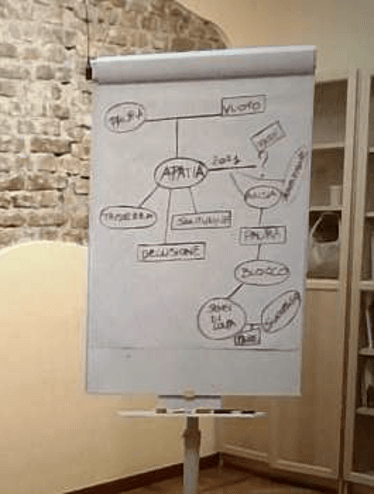 Figure 2: Second F.A.G.E.
The interview concludes when the therapist feels they have drawn fully on their curiosity—when they feel they have explored every small detail and examined every corner of the patient’s F.A.G.E. Sometimes, during the interview, as in this case, the person themselves finds “the solution”. At other times, patients assign themselves tasks, such as trying to do certain things before the next session. At other times emotionally intense events occur; experiences emerge, or strong emotions arise. At still other times nothing particularly happens: the patient may appear to have worked during the session, yet the entire process continues to circulate internally in the person’s mind. Whatever happens, the session should always be concluded—as our teachers have taught us—either with a return message that reflects what occurred during the session or with a task directly connected to what emerged in the here and now of the meeting.
THE PHASES OF THE F.A.G.E., SETTING AND GUIDELINES FOR ADMINISTRATION
The F.A.G.E. tool develops through three phases:
1. Construction
An emotion from which to start must first be selected, following a systemic hypothesis (the emotion could be the one a patient constantly brings into therapy, the one that is particularly strong for the patient at that moment, or the emotion that has activated a task or therapeutic focus). The graphic construction of the genogram of emotions then follows: parents, grandparents, possible partners, children, the relationships among them, marriages, deaths, separations, and so on—representing at least three generations. A gender and a name are then assigned to each emotion according to the patient’s personal experience of it.
2. Interview
Through questions, the therapist helps fill in the gaps, create connections among emotions, reconstruct the stories of these emotions, and explore the meanings attributed to each of them.
The therapist should not interpret the patient’s work based on their own personal experience. They must remain attentive to questioning their own assumptions, avoiding attachment to their own hypotheses and keeping their biases in mind. When asking questions, the therapist follows the six guiding principles of a systemic interview:
• hypothesizing
• circularity
• neutrality
• curiosity
• strategizing
• alternative vision
The therapist follows the patient’s elaborative thinking, reconnecting the patient’s reflections in the present moment without being carried away by the past narrative, while using the information that emerges about the past to explore how it influences the emotional system in the present.
3. Feedback / Return
The therapist may offer verbal feedback about what occurred during the session or may assign a task connected to what emerged. The choice depends primarily on how the therapist’s hypothesis about the case has evolved and, secondly, on the therapist’s style, the atmosphere of the session, and the therapeutic alliance perceived in that moment. The tool can be used in individual, couple, or family therapy settings. It can also be used with children (with appropriate adaptations) and with individuals of any age, culture, or social background. It is not necessary for the person to be skilled in recognizing emotions in order to use it. The instrument was specifically designed to work with people who have difficulty accessing or verbalizing emotions and does not require advanced graphical or verbal abilities. It can be used with a wide range of disorders and pathologies and has also been applied with pharmacologically stabilized patients with schizophrenia.
Warnings
Regarding precautions, it is important to emphasize that any professional who chooses to use this instrument should be aware that contraindications or difficulties may arise. It is a tool that should be used only when supported by a systemic hypothesis explaining why its use may be meaningful at that specific moment of therapy and within that specific therapeutic system.
This hypothesis should be able to describe:
• the patient system
• the therapist system
• the patient–therapist system
• the broader relational and contextual systems
We must also remember the contemporary assumption of the connection between emotional systems and cultural systems: the patient, family, or couple we encounter is never simply that person or that family in itself, but rather that system within interaction with the therapist. The therapist must therefore understand their own contribution to the emergence of certain emotions rather than others. Every emotion that appears in therapy is necessarily a therapeutic hypothesis and, as such, provisional (Bertrando & Toffanetti, 2003). We must also consider the cultural factor: cultures are not fixed or immutable over time but change and evolve. It is therefore essential to study emotional key terms and how their meanings change across cultures. Emotions described with different words may acquire different semantic nuances, almost as if they represented distinct forms of life (Geertz, 2000).
For more detailed specifications, see:
Citterio, N., & Iori, V. (2020). F.A.G.E. Family Genogram of Emotions – A New Tool for Working with Emotions in Therapy. Milan: Mimesis.
CONCLUSIONS: SOME EFFECTS ON PATIENTS
For therapists who remain “curious to the end,” we report some feedback from our patients after using this tool in therapy:
• “I didn’t think I could write down so many emotions; I’m very surprised! Anger, control, and justification now make more sense to me and I can distinguish them. Before, it was all just nervousness that I couldn’t name or make sense of”.
• “It’s true, I’m afraid. I’m getting older; now I’m the one who needs others. I look around and I’m alone. This creates anxiety in me… I’m telling you this for the first time and I feel a strong stomach ache”.
• “No one has ever asked me the things I wrote there. Maybe now I can begin to think about my desires and projects”.
• “I was surprised to include physical symptoms and to connect them in a way that now makes sense to me”.
• “We were surprised to see the connection our child created between fear and anger. We thought anger was only an adolescent manifestation, without realizing that it could hide fear”.
• “My sadness is actually the only emotion that produces something else. It’s not so negative… perhaps it can generate something. Looking at it written down now, I see that it can lead to courage through anger. Perhaps emotions I have always seen as negative are actually useful for reaching action”.
• “Maybe I should be more courageous and ask questions of my mother and father, worrying less about them”.
• “At this moment I feel I can finally let all my anxiety come out. All these emotions can now emerge; I don’t have to suffocate them anymore”.
• “Everything feels so clear and simple… I feel the younger Anna moving again—the one who was strong, courageous, who fought. I no longer want to give up who I am”.
BIBILOGRAPHY
Bateson, G. (1976). Verso un' ecologia della mente. Milano: Adelphi.
Bertrando, P. (2014). Il terapeuta e le emozioni. Un modello sistemico-dialogico. Milano: Raffaello Cortina Editore.
Bertrando, P., Toffanetti, D. (2000). Storia della terapia familiare. Milano: Raffaello Cortina Editore.
Boscolo, L., Bertrando, P. (1996). Terapia sistemica individuale. Milano: Raffaello Cortina Editore.
Caruso, A. (2002). Altravisione: una posizione nella conversazione terapeutica fra teoria sistemica e teoria socio-costruzionista. In Connessioni, n.11. Milano: Centro Milanese di Terapia della Famiglia.
Cecchin, G., Apolloni, T. (2003). Idee perfette. Roma: Franco Angeli.
Cecchin G., Lane G., Ray, W.A. (1997). Verità e pregiudizi. Un approccio sistemico alla psicoterapia. Milano: Raffaello Cortina Editore.
Citterio, N., Iori, V. (2020). FA.G.E. Family Genogram of Emotions - Un nuovo strumento per lavorare con le emozioni in terapia. Milano: Mimesis.
Damasio, A.R. (1995). L'errore di Cartesio. Milano: Adelphi.
Damasio, A.R. (2000). Emozione e coscienza. Milano: Adelphi.
De Silva, D. (2011). Sono contrario alle emozioni. Torino: Einaudi.
Van der Kolk, B. (2015). Il corpo accusa il colpo. Mente, corpo, cervello nella elaborazione delle moemorie traumantiche. Milano: Raffaello Corina Editore.