
Pp 71-72
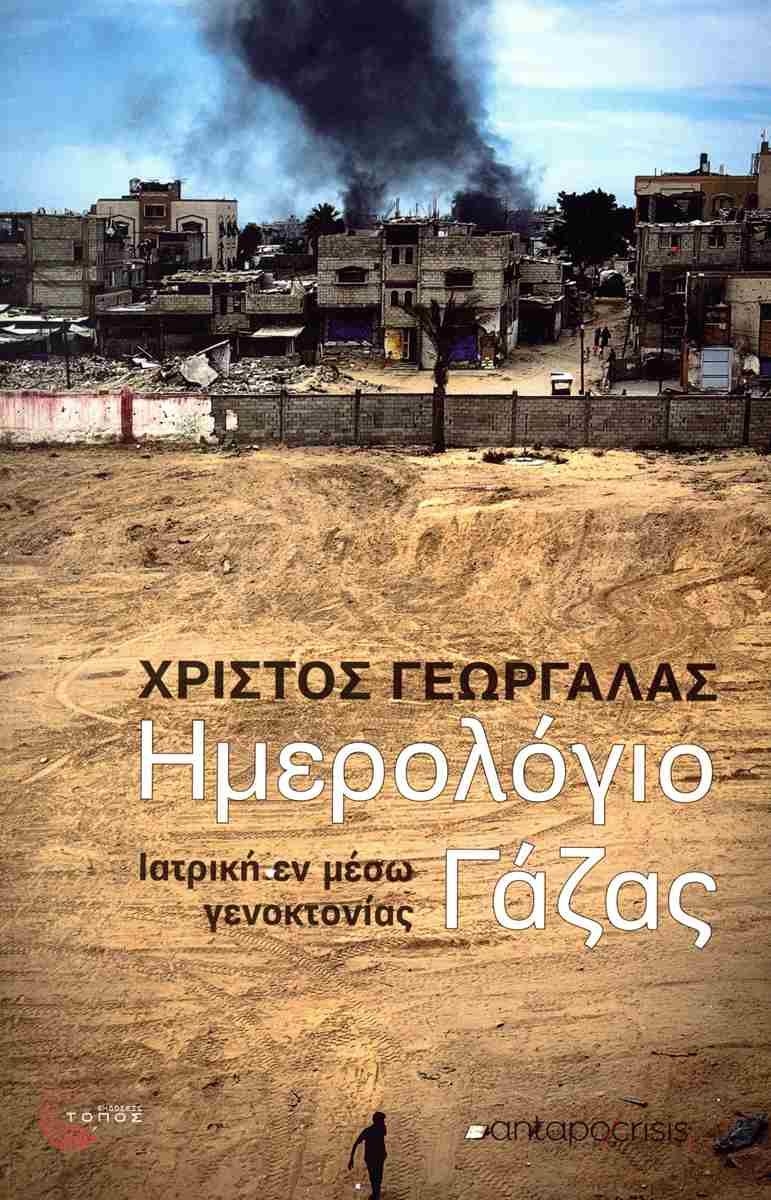
By Dimitris Kokkalis
Christos Georgalas is an ENT doctor, who is a pioneer in Endoscopic skull base surgery, and among other things a professor at the University of Nicosia.
He has participated in humanitarian missions in Kosovo, Uganda and twice in Gaza. He believes that Medicine cannot be practiced in isolation from its social context.
The present book is a diary/testimony based on his experiences during his stay and work for a month (21/04/2025 – 20/05/2025) in the Gaza strip, and specifically in a Khan Younis hospital.
As he himself states, the reason he went was “… to do his job”; namely to practice medicine, to aid the victims, and to collaborate with and train his colleagues.
He connected with the Palestinians – mainly the hospital staff – on a human level and he better understood the conditions of life and death in Gaza.
“It is a genocide. It is not a war” he writes. “It is as if the Israeli army seeks to eliminate civilians – mainly children. Despite having the capability to selectively hit isolated targets, they do not do so. They hit areas, entire buildings with civilians”.
In an interview after the publication of the book, he revealed that the Israelis would charge every Hamas fighter with the death of 50 to 100 civilians. Somewhat like the nazis during the occupation of Greece, among other places.
On the other hand, he experienced the Palestinians as people with unlimited patience and fighting spirit. People with faith in life and hope! Never did he witness shouting, cursing or the expression of hate. What was dominating was the need to save whatever was possible within almost 80 years of occupation, genocide, desolation and famine.
Most of us experience Gaza from our armchair. We cannot be there, neither would we want to. But what about our thought and soul?
People like Christos Georgalas lead our though and soul into being more present in places where man shows his greatest antitheses.
This is, I believe, the key challenge of our time. Is man mainly the bringer of life or death?
What can the role of psychotherapy be?
How can we contribute, through our psychotherapeutic role, to the reinforcement of the connection of man with the desire for life?
To what extent can psychotherapy contribute without the simultaneous synergy of collective socio-political processes?
Could it maybe trigger these processes?
Does the psychotherapeutic functioning condition allow the raising of social and political awareness? Could the basic requests of those seeking psychotherapy, that concern free expression, self-knowledge, and the improvement of personal relationships, be connected to the wider awareness of the general context? Namely our world. Is the widening of the field of vision and the multiple points of view a way to do this?
And what about values? Can we work with everybody regardless of their value system? Do we need to at least match on an elementary level in order to form a therapeutic relationship? Is psychotherapy for everybody?
On the other hand, difference is what produces a relationship. The utilisation of difference comprises the basic challenge of the therapeutic process. How much difference can we tolerate, though?
On the one hand, difference seems to be under persecution nowadays, and on the other, it comprises the founding principle of human relationships.
Coming back to the book under review, I believe that it is a shocking testimony, without embellishments or demonisations. It records the truth of a decent and very courageous man that … “just wants to do his job”.
Enjoy reading.